EMS – You Can Never Leave

Last thing I remember I was running for the door

I had to find the passage back to the place I was before

“Relax,” said the night man, “We are programmed to receive

You can check out any time you like but you can never leave”

EAGLES – Hotel California

EMS is like the Hotel California: “You can check out anytime you like… but you can never leave” the memories, faces, successes and failures will always be with us. They dim at times over the years, but they are always there. I read a thought provoking and honest analysis on being a paramedic a few months back and have been mulling over her post, digging through ramblings from my field journals and the skeleton of a story I have been working on for about 2 years… these all prompted me to ramble further…

The blog post that triggered this article is: Unless you’ve been there, you wouldn’t understand: A Paramedics farewell to the job. Posted on February 10, 2015 by Di McMath

https://dimcmath.wordpress.com/2015/02/10/unless-youve-been-there-you-wouldnt-understand-a-paramedics-farewell-to-the-job/

One of the key issues for me is the ability/or lack thereof to detach from what we are doing and seeing; this drags one into the massively dehumanising temptation of EMS. I do feel that this dehumanisation is both inexorable and dangerous – as practitioners we need to know how to halt or slow it down. After 30 years of emergency medicine practise; I am still not entirely sure if we can entirely halt the process, which is why we can never fully check-out.

Being a fan of the poetry of Wilfred Owen, and as I reread his poems on a regular basis, I was drawn back to his poems during this thought process and found some further insight on reading “Insensibility”:

And some cease feeling

Even themselves or for themselves

Dullness best solves

The tease and doubt

The poem plays along the interesting juxtaposed lines of detached versus involved, and the varied degrees of these mindsets. Those of us in the profession have over the years dabbled with both approaches, the trick is for each individual to find his/her own balance. That is all part of the process of slowing down the dehumanising process. Finding this balance is key, if we do not, then we are doomed to keep repeating the mistakes of our past (mistakes as regards emotions and those of a clinical nature).

Emergency Medicine has the ability to dehumanise and diminish or renew and expand our powers of feeling. It is our choice to decide which path to follow. We realise soon on in our profession that this is one of the many choices that we have to make. How we deal with this choice determines how we deal with another key critical decision we as practitioners in the field are confronted with at numerous times in our career. Who lives or dies, or why do some people die despite our best efforts; and the pain of admitting defeat and saying okay, we need to stop now, the patient is deceased.

It is on these crucial scenarios, that I have to agree with the title of Di’s blogpost:

Unless you have been there you wouldn’t understand – Its sounds trite, but it is so true.

Trying to explain this process of immediate Triage, that at times needs to be done in very short time frames, less than a minute, is very difficult. Those are some of the choices we can never walk away from, and even when we do make them we cannot stop thinking about “What If?” the curse and bane of every paramedic. The cursed ability to second guess yourself long after the fact on an ongoing basis. It is here where we as emergency medicine practitioners are faced with the dehumanising and diminishing or the renewing and expanding of mental and medical health.

The goal of our profession should be a living force in the quest for and prevention of human suffering, but that sometimes comes at the cost of our own mental health. As we enter, continue in and exit this amazing profession, lets consider the cost to those we have served and continue to serve. All we can do as practitioners is warn, and that is why the practitioner needs to be truthful.
Updated:

Read these 2 poems I wrote on the cost of service:

https://mikesnexus.com/2017/04/23/at-what-cost/

https://mikesnexus.com/2016/10/30/god-is-in-session/

Lights Camera Affluence

The following article is of my experiences, thoughts and observations as a set medic on film shoots, they have mostly been for the advertising industry. I have been working on film sets quite a lot lately, all about making ends meet (see closing comments). I am keeping it short and not alluding to any specific shoots/products or locations.

For the worker bees a day begins early and ends late, it is not uncommon to work in excess of 14 hours a day, excluding travelling to set., this can continue for days on end, leading to tired workers, who then make mistakes. The longer the shoot (hours and days) the more likelihood of injuries. The medic is one of the worker bees, one of the first to arrive and last to leave, we also serve a safety supervisory role (although with very little power, unlike in the construction industry where we can stop poor unsafe work). The medic fills a strange role, we are an essential service, shooting cannot happen without our presence, but that’s were it it sometimes ends. We are the adult baby sitters of the film set industry.

It is a strange world within a world, a peculiar insular existence, divorced from the reality of the day to day grind of the real world. It is possibly a very jaundiced view of society at large, on a micro scale. Although at times some of the hierarchy takes their positions to the extreme (in my opinion), with their strange demands and need for someone to always be at their beck and call. It is a world of chaperones, chauffeurs, PA’s – whose primary function is to be an espresso on tap machine (everyone has a PA, except the medic). I asked one of the PA’s how some of these people (senior crew and foreign actors) cope at home; the reply was classic: “They must still live with their mothers” 🙂

Summer shoots are possibly the worst (as the daylight shooting hours are so much longer); and the medics primary role is to dispense sunscreen and having to tell foreign actors and crew to drink fluids and apply sunscreen, which they never do… and then you have to assist them later gggrrr. An area of the industry that sits uncomfortably with me is when the child and baby “actors” that get trotted out, they at most times have no say in the matter and their parents seem to live their acting lives out , vicariously through their children or babies. Adult actors have a choice, but the kids not. They live a bored restless existence on set, in some cases just wanting to go home. The medic has to make sure that they are looked after and on hot summer days doing outdoor beach shoots this taxes one to the extreme.

I do battle to deal with the mindset of some of the people, and then their are the worker bees like myself (who have been doing this for years) and for them it is just a job, and is not office or desk bound, and for that they are happy. Many of these individuals acknowledge the concerns and issues when we sit and chat on the many slow days. It pays the bills and puts food on the table or their kids through school. They choose not to look beyond that. I suppose if one digs deep enough in any profession you will encounter similar issues, that the worker bees just live with.

The cynic in me has now come out… so stop reading if you do not want to read my cynical exposition of the ad/film industry.

When you look at the money spent on marketing to sell your next burger, cool drink, car, or dish washing liquid. Is it worth it? The cost of your next purchase carries all this marketing embedded in its base cost price, would it make the cost of goods cheaper if ad budgets were smaller?

Many jobs are created by these industries, but at the end of the day does the advert actually add value to the product? To what end is this entire process, as it becomes hugely self sustaining, and reliant on the general public to keep buying into this process, to which they are more than willing to comply.

A Sonnet of Requited Passion

Trying my hand at writing a sonnet… lets see how it goes (my first sonnet) inspired by and dedicated to my wife 🙂

Oh the journey of danger

Begins with the form,

Of one who is not a stranger

But rather with a burning storm


Passions unleashed by ones love

As the dangerous flowing curves

Of her female form are void

Of all clothing and other womanly reserves


Laid bare to the silhoutte

Of the fading streaming golden sunlight,

As the two-tone colours on an artists palette

Raising raging desires to a height


All these passions can only be sated

Once heightened passions have abated


© 2015 Michael D Emmerich

What’s Louder Than Words?

the crack of a rifle firing
in the forest or field of war
wailing siren of a rushing
an approaching ambulance
cutting through the black night

continuous wailing of a house alarm
shattering the darkened silence
hard rain falling on a tin roof
interrupted by the crash of thunder

Thoughts, visions, images
screaming louder than words

wind whistling through the lush pine trees on a mountain slope
gentle sound of a purring cat
nuzzling against ones neck
grating sound of a key in lock
as a loved one comes home

thoughts, visions, images
whispering to ones soul

silence... the sound of silence
haunting, reassuring, affirming, alarming, hypnotic

thoughts, visions, images
evoking pictures of silence

be silent, listen to your heartbeat
and just be
SILENCE
sometimes the loudest words
are the ones never spoken


© 2015 Michael D Emmerich

The Ven of Life

Over the past few days a good friend of mine passed away, and upon his passing, and it has dragged me along to think of death, the fragile state of our existence and how quickly and unexpectedly the candle can be snuffed out. It made me remember something my dad said before he died: that its a sad day when you get to the stage of your live when your friends start to die around you … having lost a few friends of late, all in their mid 50’s, I have had cause to gaze introspectively at my navel, and just contemplate life.. and all its joys, friends, family and time spent with them, recollections of past events/encounters, and all the pleasure that these interactions have brought.

For those who know me, they would say that it is an irony that I get so closely caught up in death, with all its pain and emotion, seeing as though I have seen so much of it in my career, in so many places and caused by so many different events. All that prevents me from getting dragged into the quagmire of death; is my ability to insulate myself, build a wall…although that has also been to my own detriment, and I have, of late become more immersed in the death and pain which I encounter in my daily walk.

All these thoughts, emotions and reflections have moved me to pen this poem:

The Ven of Life

all that we are and have is our emotions

interactions and experiences

all that we have is the ven of our lifes

as we journey through life we cross paths with strangers

friends, family and loved ones


it is these paths that cross

intersect which drag us into the ven

the bigger the interaction the greater the ven

the more we interact the more we ven

we cannot exist without interacting


the extent of our interactions increases our circle

the more we interact the more we overlap

seeking to be apart of the greater universal circle

the commonality of our existence increases our ven

the more walls we break down the more we interact

the more expose ourselves to risk and become more fragile


this fragility increases our ven

which then enriches our lives

only through the ven of life
can we fully enjoy and appreciate

all that life has to offer

so ven on!

© 2015 Michael D Emmerich

MOTOR VEHICLE ACCIDENTS – A GROWING PUBLIC HEALTH BURDEN

My latest Blog post for This Week in Global Health:

http://www.twigh.org/twigh-blog

Road Traffic Crashes do not just happen! They are caused by Fatal Moves (actions) by a driver. The message is simple – DON’T DO FATAL MOVES!” @FatalMoves

1990 to 2010: Deaths from road traffic injuries increased by almost half.

The largest category of fatal events are transport related. In 1990, according to Global Burden figures, these were the 10th leading global killer. By 2013, they were fifth! Ahead of malaria, diabetes, chronic obstructive pulmonary disease, cirrhosis or any kind of cancer. In part, this is because of progress against these diseases. But it also because as incomes have risen worldwide, more people are buying, and crashing, motorbikes and cars.

Most global road traffic deaths occur in low and middle-income countries and are rapidly increasing because of the growth in motorisation. Mortality rates caused by traffic related injuries are increasing in low and middle-income countries and they account for 48 percent of the world’s vehicles but more than 90 percent of the world’s road traffic fatalities. Pedestrians are most often affected, followed by car occupants and motorcyclists. Alcohol plays a key factor in the drivers and pedestrians, notably in South Africa, where as many as 65% of all pedestrians have increased blood alcohol levels. Conversely, traffic deaths are decreasing in high-income countries, Sweden is an excellent case study that we will review further on in this article.

10 countries are responsible for 600,000 road traffic deaths annually (see the MikeBloomberg link in the references below, to see if your country is on the list). Each year, 1.3 million people die in car accidents, so these 10 countries are responsible for nearly half of all road deaths! India tops the list for the highest overall number of road deaths, followed by China and the U.S.

If public health leaders are to catch up on accident prevention, the Global Burden of Disease study (Lancet links below) findings can help them see where and how. “Now that somebody’s done the work and we recognize that there’s a difference we may not have seen before, we can go to work and ask why,” said Dr. Schauben

Besides the rapidly rising fatalities we must also take cognisance of the rising number of injured persons and their cost on the (Global) health burden. Road-traffic crashes were the number one killer of young people and accounted for nearly a third of the world injury burden, a total of 76 million DALYs (Disability Adjusted Life Years) in 2010, up from 57 million in 1990. Most of the victims were young, and many had families that depended on them, who know have to rely on other sources of support, in most instances, the state.

What does the current research then tell us about this rapidly rising burden on global public health; transport injury prevention shows that collective action is as important as individual efforts. Motorcycle helmets, car seatbelts and sober drivers are important, but so are safe vehicles, consistent law enforcement and a reliable infrastructure. Thanks to a combination of insufficient, nonexistent or poorly enforced safety laws, poor infrastructure and a lack of enforcement and corrupt enforcers, the bulk of the countries globally keep aiding and abetting in the deaths of over 1.3 million persons annually! Only 28 countries, representing 449 million people (7% of the world’s population), have adequate laws that address all five risk factors (speed, drunk driving, helmets, seat-belts and child restraints). Over a third of road traffic deaths in low and middle-income countries are among pedestrians and cyclists. However, less than 35% of these countries have policies in place to protect their road users.

India has the dubious distinction of registering the highest number of road fatalities in the world (250,000), despite the fact that its population is much smaller than neighboring China and there are more vehicles on the roads in the USA than in India. “A large proportion of these deaths can be prevented by simple measures. The most important of these is strict enforcement of traffic rules, which is conspicuous by its absence in our cities as well as on highways,” says the Times of India, and this would be true of the top 10, and also of the country where I reside, South Africa, where 47 persons die each day!

Further compounding the cost of the traffic fatalities is the actual real cost impacting on the affected countries economies; many who cannot afford to have the extra burden on their already strained public health budgets. The economic cost of road collisions to low and middle income countries is at least $100 billion a year! The risk of dying as a result of a road traffic injury is highest in the African Region (24.1 per 100 000 population) It’s such a big problem, in fact, that the U.N. feels it needs an entire decade to fix it. In 2011, the U.N. launched a “Decade of Action” that aims to “stabilize and then reduce” global road traffic fatalities by 2020.

Is there any good news? Sweden is one success story, in 2013 only 264 people died in road crashes, a record low. How have they done this? Planning has played the biggest part in reducing accidents. Roads in Sweden are built with safety prioritised over speed or convenience. Low urban speed-limits, pedestrian zones and barriers that separate cars from bikes and oncoming traffic have helped. Globally we need to reduce human error, or eliminate the opportunity for drivers to make fatal moves; human error can even further be reduced, for instance through cars that warn against drunk drivers via built-in breathalysers and making the implementation of safety systems, such as warning alerts for speeding or unbuckled seatbelts/child-seats, compulsory on all new vehicles, built in any factories across the globe.

Individually we need to be aggressive in safe and sober driving habits and not allow our friends and family to place themselves, their passengers and fellow pedestrians at risk by not looking kindly on their unsafe driving practises. Bad and drunk driving should become as unpopular as using a cellphone while driving.

References:

http://www.thelancet.com/journals/lancet/article/PIIS0140-6736%2814%2961682-2/fulltext

http://www.thelancet.com/journals/lancet/article/PIIS0140-6736%2812%2962037-6/fulltext

http://www.worldlifeexpectancy.com/cause-of-death/road-traffic-accidents/by-country/

http://apps.who.int/gho/data/node.main.A997

http://apps.who.int/gho/data/node.main.A998

http://mikebloomberg.com/Bloomberg_Philanthropies_Leading_the_Worldwide_Movement_to_Improve_Road_Safety.pdf

MANAGING THE GLOBAL BURDEN OF CHRONIC ILLNESSES

An article on an EMS blog caught my eye in the past week:

COPD was the third-leading cause of death in the U.S. in 2011 and is expected to become the third-leading cause of death worldwide by 2020.

Source:

Hoyert DL, Xu JQ. Deaths: preliminary data for 2011. Natl Vital Stat Rep, 2012; 61(6): 1–65.

Lopez AD, Shibuya K. Chronic obstructive pulmonary disease: current burden and future projections. Eur Respir J, 2006; 27(2): 397.

This caused me to dig up a presentation I did in 2006 at a Fitness Seminar, wherein I was discussing chronic medical conditions, which are caused by poor lifestyle choices and I noted then:

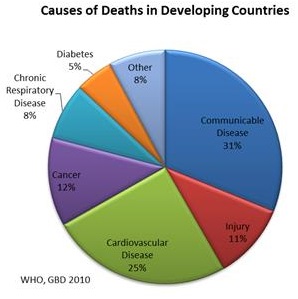
In 1999 CVD contributed to a third of global deaths. In 1999, low and middle income countries contributed to 78% of CVD deaths. By 2010 CVD is estimated to be the leading cause of death in developing countries. Heart disease has no geographic, gender or socio-economic boundaries.

I further stated:

Chronic illness have overtaken communicable disease as a major cause of death and disability worldwide. chronic diseases, including such noncommunicable conditions as cardiovascular disease, cancer, diabetes and respiratory disease, are now the major cause of death and disability, not only in developed countries, but also worldwide. The greatest total numbers of chronic disease deaths and illnesses now occur in developing countries.

I then dug deeper to see how this has changed since 2006, and the outlook has become even more bleak!

More than 75% of all deaths worldwide are due to noncommunicable diseases (NCDs). NCD deaths worldwide now exceed all communicable, maternal and perinatal nutrition-related deaths combined and represent an emerging global health threat. Every year, NCDs kill 9 million people under 60 years of age. The socio-economic impact is staggering. These NCD-related deaths are caused by chronic diseases, injuries, and environmental health factors. Important risk factors for chronic diseases include tobacco, excessive use of alcohol, an unhealthy diet, physical inactivity, and high blood pressure.

The world now suffers from a global epidemic of poor lifestyle choices! Medically we call them chronic illnesses or NCD’s, but the issue at hand is that they can be avoided, reversed and prevented; with smarter lifestyle choices. The why and the how of these lifestyle choices is a debate for another blog, but poor socioeconomic conditions, poverty, malnourishment and diets deficient in basic nutritional building blocks all form part of this dynamic.

These poor lifestyle choices and the death, illness, and disability they cause will soon dominate health care costs and should be causing public health officials, governments and multinational institutions to rethink how they approach this growing global challenge. To exacerbate the matter; the deaths, illnesses and disability are spiralling at even faster rates in the developing world, where the infrastructure is even weaker than in the developed world.

causeofdeathdevelopingcountries

It is estimated that by 2020 the number of people who die from ischemic heart disease will increase by approximately 50% in countries with established market economies and formerly socialist economies, and by over 100% in low- and middle-income countries. Similar increases will also be found in cerebrovascular disease (Stroke) by 2020!

This is indeed a frightening prospect; NCDs are expected to account for 7 of every 10 deaths in the world! The overextended healthcare systems in Africa and Asia will battle to cope with these spiralling patient numbers.

A (positive) point to ponder as we consider this bleak outlook; the principal known causes of premature death from NCDs are tobacco use, poor diet, physical inactivity, and harmful alcohol consumption – all of these are preventable and manageable; as they relate to personal choices. Therefore we need to focus on creating a environment where these same individuals can make the correct choices which will have a positive impact on their lives. This is where governments, aid agencies and multi-nationals should focus their energies, and the approach should be more carrot than stick, which is not the case at present.

Reference’s:

http://apps.who.int/iris/bitstream/10665/128038/1/9789241507509_eng.pdf

CORPORATE RESPONSIBILITY AND DUTY OF CARE – HEALTH INSURANCE AND ASSISTANCE

“Between one in two and one in three expatriates has no international health insurance”
International Private Medical Insurance Magazine from the report: International And Expatriate Healthcare And Insurance 2014

I believe this to be a very accurate statement notably, with regard to the African continent (where I spend most of my time), this figure might even be flattering to some companies employing expat staff in Africa.

The globally mobile population has grown dramatically. There are over 50 million expatriates, and by 2020 this will be 60 million. 232 million people now live away from their country of birth.
Between one in two and one in three expatriates has no international health insurance, although a minority is covered by domestic health insurance. Several countries seek to get expatriates and migrants to pay for healthcare or have compulsory health insurance.

This is a disturbing issue, as too many companies are happy to send their staff abroad, or to remote work sites, without any or inadequate medical cover; be it insurance or assistance. This shows very poor duty of care. In discussions with some of these companies, when trying to assist them with advice on even basic assistance packages or client managed services, their responses are troubling; when viewed against the light of corporate responsibility and duty of care. To defer the responsibility to the employee and abdicate corporate responsibility, should be cause for concern.

The duty of care of the employer, is a term that is often thrown about and The UN Global Compact, is one way that companies are being encouraged to show a greater duty of care, although some would cynically say that Corporate Social Responsibility is a box-ticking exercise, companies are just paying lip service, but do no more than is necessary to avoid affecting the bottom line. The UN Global Compact, is engaging over 8,000 companies in more than 145 countries on human rights, labour standards, environment and anti-corruption, hopefully at the same time pushing to commit to a sustainable workforce, via duty of care and corporate social responsibility.

The level of care offered by companies, will depend where the company is registered, as to what laws could be enforceable, hence most companies register an off-shore shell for hiring, staffing and contracts. (this is in itself a topic for another day – relating to contracts, taxes etc.)

Possibly other avenues should be explored, with respect to medical assistance/insurance; by pushing that investors use their muscle, ensuring that their investment capital is being well managed. Staff that cannot be properly cared for (ex-pat and local), via medical cover that is in place, place a further drain on company resources, shifting capital away from its intended purpose. A well managed corporate health care plan, ensures ongoing confidence in the company.

Till now I have only been speaking about expat staff, but the issue of medical care for local staff would also need to be addressed, in fact poor care for expat staff, could be viewed as an indicator of poor care for local staff. The ever growing impact of business on society means that staff, investors and consumers expect corporate power to be exerted responsibly, the corporate community will have to step up its game and build greater trust with respect to duty of care. Business are being expected to do more in areas that used to be the exclusive domain of the public sector – ranging from health, education and to community investment.

Having insurance/assistance programs from reputable companies, linked to well managed onsite managed health care programs, which is in place for ALL staff, makes good business sense. This then empowers staff to work safely in environments that might be deemed risky, allowing them to work with confidence and be fully focussed on their daily tasks.

Reference’s:

http://www.researchandmarkets.com/reports/2788557/international_and_expatriate_healthcare_and

https://www.unglobalcompact.org/abouttheGC/thetenprinciples/index.html

Bob Dylan and His Many Muses

In Paul Zollo’s book “Song Writers on Song Writing”, the expanded 4th edition, in teh interview he held with Bob Dylan; Dylan makes an interesting comment, in how often songs “come to him”. That’s how he could write “Blowing in the Wind” in 10 minutes, which he says came right out of that well spring of creativity.

Does Dylan think he can do it again today? No, says Dylan. “You can’t do something forever,” he says. “I did it once, and I can do other things now. But, I can’t do that.” when speaking to Ed Bradley on 60 minutes in 2004. he also goes onto to say: “I don’t know how I got to write those songs. Those early songs were almost magically written,”

Dylan seems to be saying that his muse, that wellspring of creativity he so magnificently tapped in that golden era of the early sixties, is gone and he is not able to access it anymore. Thom Hickey in his article You really should have been there says:

“Over the next 47 years he would never again attain the heights of inspiration achieved through to 1966 (neither would anyone else!)”

Before he even attained those great heights in the of the mid-60’s he was already writing lyrics that would never be matched. My favourite Dylan protest song “Masters of War” was written when he was just 22! Released in 1963 on his Freewheelin’ album, the message is timeless and still relevant to all the current ongoing conflicts across the globe.

Dragging the conversation back to its original question, has Dylan lost his muse and can one just lose your muse? Webster’s dictionary defines a “muse” as any of the nine sister goddesses presiding over song, poetry, the arts and sciences. Greek mythology aside, writers think of a muse as a source of inspiration, a guiding genius rife with ideas. Writing teachers say one way to not lose your muse is  “Just keep your hand moving and write!”- be your own muse.

Dylan has most certainly done that, he has published six books of drawings and paintings, released 36 albums (excluding live albums and bootlegs) and written well over 500 songs …and counting…

That wellspring of creativity, has sustained Dylan for more than 50 years, and it keeps on giving, and he keeps telling his tales in a different way, with each telling. People who attend his concerts say, that they do not even recognise some of his songs as being their favourite, until halfway through, he keeps experimenting, reinventing himself and his music. I think his muse has changed, if we track his career/life and all the transitions/phases he has gone through, he certainly does not have that 60’s muse anymore, but has proven he still has the craft and the gift. Although Dylan might disagree:

“I’m a ’60s troubadour, a folk-rock relic. A wordsmith from bygone days. I’m in the bottomless pit of cultural oblivion.” – 2004

His last album, Tempest, still proves he can tell a great story, despite his voice being a bit more gravelly. The title track still gives me goosebumps when I listen to it…all 15 minutes of it!

Tempest is fantastic, but being impressed by Dylan is old hat. That he still finds ways to surprise us is an achievement beyond all comprehension. -American Songwriter 2012

His angry protest song Pay in Blood, from the same album – Tempest – brings back memories of his 60’s anger. You can hear his anger, his sneering voice as he growls and rasps over cutting and biting lyrics.

“Another politician pumping out the piss,” he sings later, the microphone audibly struggling to cope with the ferocity of his delivery. “You bastard, I’m supposed to respect you? I’ll give you justice.”

Dylan does not soften the blow here, as he does on Like a Rolling Stone, he vents his anger fully, proving that he can still be angry and anti-establishment in his 70’s 🙂

Possibly one of Dylan’s muses is/was his first wife Sara. She is definitely a key player in Dylan’s history and worthy of remembrance as the inspiration for some of his most incredible songs. Notably Sara and Sad-Eyed Lady of the Lowlands. Sara is possibly Dylan’s most public display of his own personal life, and an ambitious tribute to his wife, Sara. The song also gives us a rare glimpse into the intensely personal and closed life Dylan leads. Rarely does he address a real person in his music, here he does and it is very autobiographical.

Bob Dylan – Sara from the album “Desire”

This was released in 1976 on the album Desire, Sara and Dylan were divorced the next year in 1977. They have apparently remained close (despite the acrimonious divorce) and they have still travel/holiday together. In fact his son Jakob said:

“My father said it himself in an interview many years ago: ‘Husband and wife failed, but mother and father didn’t.’ My ethics are high because my parents did a great job.” Jakob Dylan – 2005

Well we wish Dylan and his many Muse’s well, he has provided us with many thought provoking and entertaining albums through the years and I believe he still has songs left in his well, its not dry yet, or dark.

The Solace in the Silence

I was driving listening to one of my favourite guitarists the other day, David Gilmour (have all my favourite Pink Floyd and all his solo albums on a play-list). Listening to his guitar work made me realise, what makes him of of the greatest guitarists (in my humble opinion), because of the chords he does not play… the silence inbetween his chords, when he plays a chord… strums/plucks the string/s … and then waits….. that waiting for the next chord to me is at times the best part of his music. That for me is what makes Gilmour such a magnificent guitarist, to me he is the master of the sublime and the understated. To make a statement or impression one does not need to make a noise, neither does one as a guitarist need to rip, shred or wail.

The pause resonates, this then took my mind off on one of its (many) tangents. 🙂

The importance of the unsaid versus the said, the importance of what is not said, in the moments of silence. Interestingly my favourite Pink Floyd album is Wish You Were Here, and it is ironic, that the album explores themes of absence (silence). The lyrics encompass Roger Waters’ feelings of alienation from other people, notably within the band and the tension that they were experiencing.

Well back to my musings of the silence between the chords and lets explore this dynamic in life; lets explore how the silent conversations can benefit our relationships and way of life. The comfort of being in someone’s presence and just being … silent …. the silent conversations we have with a loved one or close friend. This silence does not alienate, but brings us closer together, we find comfort, solace in the silence. The importance of silence in conversation can carry more weight than the spoken word.

The silence echoes around the enclosed walls of our minds, encouraging us to break down the alienation and find solace in the silence, and learn the importance of being silent, quiet … amongst those we feel close too, and then taking this silence out into the rushed and frenetic world in which we live. This can help us to slow down in the fast paced world we live in, for when speed is king, anyone or anything that gets in our way, that slows us down, becomes an enemy. Thanks to speed, we are living in the age of rage. That to is ironic, the fast pace of life alienates more than the comfort we can find in silence.

By opting out we do not have to drop out…