Learning from Creative People – Bob Dylan

I have been making a concerted effort of late to spend at least an hour a day reading books on creativity and/or interviews with creative people (mainly writers, artists and musicians); to understand what inspires them, how they work, where they work, and how they tap into their creativity to access the ideas/inspiration which allows them to write with such beauty and intensity.

A hefty tome that sits on my desk at present is “Song Writers on Song Writing”, the expanded 4th edition by Paul Zollo.

http://www.amazon.com/Songwriters-On-Songwriting-Revised-Expanded/dp/0306812657

It covers every genre of music form blues to pop and rock, interviews with 62 musicians/song writers. What is so interesting and inspiring for me, when reading the interviews is to discover that not all the writers just grab the lyrics from the air, some of them really anguish over them. Leonard Cohen took 3 years to write Hallelujah!

I have spent the last week, reading the Bob Dylan interview over and over again; I am a huge Dylan fan, have almost his entire song collection on vinyl and mp3, plus all his song lyric sheets and numerous biographies. For me he is a musical genius and one of our greatest living poets. Van Morrison agrees with me re him being our greatest poet 🙂

His comments on the environment that one needs to be creative ties in with what I read in the War of Art; one needs a peaceful, invigorating and stimulating environment to write. Although he does go on to say:

“Some songs are better written in peace and quiet and delivered in turmoil. Others are best written in turmoil and delivered in a peaceful, quiet way.”

He also says that he does not consider himself a professional song writer, and he clarifies this by saying it has always been more con-fessional that pro-confessional. That got me thinking about my writing, and what aspect/perspective am I writing from, i.e. inward or outward looking, and just how naked does one want/need to be, how close to ones “soul” must we dig, when one is writing?

Dylan refers often to how songs “come to him”, which brings me full circle to the muse/genius train of thought. Even if that is the case though you need to be receptive to the “arrival” of the inspiration. This is an area of my creativity that intrigues me, especially as I am science, logic and process driven. Despite this I too am finding ideas coming to me at strange times of the day and night.

Well that’s enough of my musings today, but I will be back with more ramblings and thoughts on making the entrance hall welcome for the muse/genius to arrive, and spoil me with his/her thoughts/dreams/visions.

Eternity is in love with the creations of time – William Blake

The War of Art

I just finished reading this fascinating book by Steven Pressfield yesterday and want to share some of what I learnt/discovered during the process.
http://www.stevenpressfield.com/the-war-of-art/
http://www.amazon.com/The-War-Art-Through-Creative/dp/1936891026

The book subtitles itself as:
“Break through the blocks and win your inner creative battles”

I highly recommend this read, I found it both inspiring and thought provoking it also has pushed me to think deeper about what it means to be a writer and the responsibility that the tag carries.

Here are a few extracts which have got my mind buzzing: (I have paraphrased or changed some of the sentence layouts to make sense to me), but they are still Steven’s words.

The professional seeks order and eliminates chaos from his world and he wants the threshold swept and kept clean, so that the Muse may enter and not soil her gown – page 77

We must not become distracted by our own nonsense – page 123

The instinct that pulls us toward art is the impulse to evolve, to learn, to heighten and evaluate our consciousness. The Ego hates this. Because the more awake we become, the less we need the Ego. – page 140
This is a form particular interesting few chapters that delve into Jungian psychology. It explains the difference between the Self and the Ego and how having an understanding of this can nudge us towards our goal of being a writer/artist.

Our biggest fear holding us back, might be the fear that we will succeed, that we will become the person that we sense in our hearts we truly are; the artist/writer. – page 143

And his closing sentence at the end of the book (spoiler alert) 🙂

Don’t cheat us of your contribution. Give us what you’ve got!

This is so true, let just do it .. and write, paint, create, lets achieve our own greatness.

“Whatever you can do, or dream you can, begin it. Boldness has genius, magic and power in it. Begin it now.”  – WH Murray

← Back

Thank you for your response. ✨

Thoughts on getting lost as a means of finding oneself…

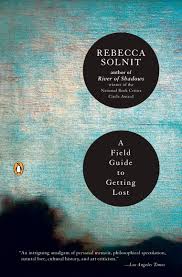
Rebecca Solnit, whose mind and writings are among the most consistently enchanting of our time, explores this tender tango with the unknown in her altogether sublime collection of essays in A Field Guide to Getting Lost 

I thoroughly enjoy her writings, having indulged in a few of her books and essays. And Getting Lost is one of the more personally transformative collection of essays I have had the pleasure of reading. Solnit, explores themes and issues of uncertainty, trust, loss, memory, desire, and our place on this planet.

Solnit writes in the opening essay:

Leave the door open for the unknown, the door into the dark. That’s where the most important things come from, where you yourself came from, and where you will go. The things we want are transformative, and we don’t know or only think we know what is on the other side of that transformation. Love, wisdom, grace, inspiration — how do you go about finding these things that are in some ways about extending the boundaries of the self into unknown territory, about becoming someone else?

Henry Miller wrote: “On how one orients himself to the moment, depends the failure or fruitfulness of it.” we are all apart of this transitional process called – Life.

“There is an illusion of ‘end,’ a stasis seemingly like death. But it is only an illusion. Everything, at this crucial point, lies in the attitude which we assume towards the moment.”

Henry Miller

T.S. Eliot’s poem Four Quarters –  expounds on the journey of life and its self discovery, and ultimately learning to know ourselves. we are on a never-ending lifelong journey of exploration – of our self, environment, the world in which we live.Life is a destination, but prehaps we never really travel further than we really are at this present moment, all that changes is our understanding of the now …

“We shall not cease from exploration
And the end of all our exploring
Will be to arrive where we started
And know the place for the first time.”
T. S. Eliot, Four Quartets

The things we want are transformative, and we don’t know or only think we know what is on the other side of that transformation. Sometimes we have to lose ourselves to find ourselves. Never to get lost is not to live.

index

Wise words from Bob Dylan

It’s not to anybody’s best interest to think about how they will be perceived tomorrow. It hurts you in the long run.

Still in Turmoil… but getting settled

Well I am back and settling down to my new routine and getting my new studio/office up and running. Have been spending time developing one of the 3 projects I am working on (it has been tricky, being creative when one is moving, travelling, unpacking).

Have spent this time fleshing out a detailed introduction and end chapter, and am now adding weight to the main body of the novel and doing the necessary research to add more substance to the plot. Miss the large whiteboards that I would need to mind map my project better and also my sketch table…as I find that I do doodling and sketching of certain sections/concepts of the novel, it helps me with my ideas and to map out what goes on in my mind (scary thought!). Anybody else use sketching/doodling to help with the creative flow??

I have also found that by selecting music that I feel best suits the project, has been very useful in adding more creative input in my writing process. I have made a playlist for this project and have found this to be very useful, for added inspiration and additional ideas for the novel.

That’s it for now, hope to be posting more as I move forward.

10 Contemporary Poets You Should Know

poetry… one of my sources of inspiration, plus it also feeds my muse… always looking for new poets to read, thanks

Busy, Busy…

I am going to be so busy the next few days, moving countries between now and next week; packing up a house, moving my cats and then also my wife and I are packing our suitcases and jumping on that jet plane. We will get to our destination first, cats a few days later and our container of possessions within the next 4 to 6 weeks. I am going to miss blogging regularly over the next 7 to 14 days as I was just getting into my new writing routine.

My daily routine of writing, and my creative hours meant to be logged at my desk are going to fall by the wayside, but I will be keeping my notebooks with me (reverting to pen and paper – which I still prefer) and eventually within the next week or two play catch up here on the site. The positive is that I will then be setting up my new writing studio/office, complete with white boards and black boards for all my mind maps that I create when I write, plus a new calm and serene writing area, it will be very stimulating.

I am hoping to post a few completed haiku’s plus the completed short story “A Groom’s Tale”, until then please enjoy my other posts and feel free to comment or add your own Haiku’s.

Bon Voyage to you all


Linking Music to Writing

Music makes my world go round, as they say; and depending on my mood and what and where I am (and doing), I listen to different musical genres, music plays a role in my relaxation, work and exercise, so why not with my writing. This post is all about linking a theme song or a few songs to a particular piece of writing.

I am currently working on 2 pieces of literature, both fiction, the one piece is very closely linked to personal experience. Whilst mind-mapping the two “books” and also doing additional research, my thoughts kept going towards what music would assist me in my thinking process and then my mind went on one of its well known tangents … just ask my wife:)

If my books were a “movie” what would the title/theme song be, and what other music would be apart of the production.

I am not sure if this tangent is one of my ways of procrastinating (when I am supposed to be churning out my 1000 words a day) or another way to find further inspiration and motivation; which will allow me to explore the writing process at a deeper level. Let us just say for now, it is a way to find further inspiration, and if that is the case here are the songs that I would intertwine with the respective projects that I am currently immersed in:

Triage:

Theme Song:

Pay in Blood – Bob Dylan (Tempest) very dark song

During the Movie/Book as a refrain:

Shine on you Crazy Diamond – Pink Floyd (Wish you were here)

Closing Credits:

To One in Paradise – The Alan Parsons Project (Tales of Mystery and Imagination)

10 Years After:

Theme Song:

What a Wonderful World – Louis Armstrong (its a powerful uplifting song but if you have watched how it is used in “Good Morning Vietnam”…then that is the feel I am gong for here… the juxtaposition of the feel good with the evil that men do)

During the movie/book as a refrain:

Cavatina – John Williams (theme song from the Deer Hunter)

Closing Credits:

I Talk to the Wind – King Crimson (In the Court of the Crimson King)

Well that’s my brief overview of words, music and inspiration, I would love to hear from others out there if you have explored similar avenues when looking for further inspiration when sitting down too transfer the thoughts from your muse to paper.

the Haiku Challenge

Haiku has been called “unfinished” poetry because each one requires the reader to finish it in his/her heart.

Unlike Western poems, haiku generally don’t rhyme.

Haiku poets may write poems that are just a short fragment with three or fewer words.

Try writing a “mini-haiku” with 3–5–3 syllables.

Draft and redraft every poem until the meaning is perfectly expressed.

Haiku are about moments of objective experience, not subjective interpretation or analysis of those events.

….

let the challenge begin 🙂

Thoughts on feeding ones muse/daemon/genius

What is the best “diet”to feed ones muse…

Reading other writers works, poetry and texts on creativity and inspiration

Playing word association games; write the first word that comes into your mind and then try and associate other words/phrases to that word… and then just writing/journalling

Must return to this as I move forward in this adventure


Image