Politics and Medicine

Politics and Medicine

“Medicine is a social science, and politics is nothing else but medicine on a large scale”—Rudolf Virchow

Politics is defined as “organised human behaviour”, thus we can postulate that Medicine is micro managed organised human behaviour, at times right down to the molecular level. If we examine the Ebola outbreak/s (globally) and how it is being managed on a macro (politics) and micro scale (medicine) we can begin to see the cracks in the system, and hopefully then move to addressing these cracks, before they begin yawning chasms that are not repairable.

The region (Liberia, Sierra Leone and Guinea) has had success (we could add Nigeria and Senegal to the successes) and failures in both areas. Neither is Spain and the USA exempt from this analysis as can be noted from the various press releases (government and medical) over the past few months.

Since the first outbreaks in 1976 (Sudan and The DRC) till the current one in West Africa; care has generally been palliative and symptomatic, questions have often been asked during this period; What of a vaccine and/or other means of treating the infected patients? There was a report in the British Sunday Times (12/10/14), cited a Cambridge University zoologist as saying that “it is quite possible to design a vaccine against this disease” but reported that applications to conduct further research on Ebola were rebuffed because “nobody has been willing to spend the twenty million pounds or so needed to get vaccines through trial and production”. Globally this has been one of the failures of the pharmaceutical companies, and most probably even the WHO, for not pushing harder over the years to get this in motion.

In her 1994 book The Coming Plague: Newly Emerging Diseases in a World Out of Balance Laurie Garrett: warned that there are more than 21 million people on earth “living under conditions ideal for microbial emergence.” Garrett when on to win the Pulitzer Prize in 1996 for reporting on Ebola. In 1995 Joshua Lederberg, the American molecular biologist said: “The world is just one village. Our tolerance of disease in any place is at our own peril. Are we better off today than we were a century ago? In most respects, we’re worse off. We have been neglectful of the microbes, and that is a recurring theme that is coming back to haunt us.”

Jump forward to the 23rd of September 2014, US President Obama issued an unprecedented ‘Presidential Memorandum on civil society  recognising that:

Through civil society, citizens come together to hold their leaders accountable and address challenges that governments cannot tackle alone. Civil society organisations…often drive innovations and develop new ideas and approaches to solve social, economic, and political problems that governments can apply on a larger scale.

If we look at the current crises in West Africa civic leaders are what is missing, hence the inability to track and trace potential infected persons, motivate communities to change risky behaviours (handing of the deceased), agitate with government to create better health care systems, this all adds fuel to the fire of the current epidemic.

Have we listened and learnt as governments, NGO’s and Multinational Pharmacare companies since then?

Despite Medical Advances, Millions Are Dying, this is a banner from 1996, not 2014! from the WHO, which was “declaring a global crisis and warning that no country is safe from infectious diseases, the World Health Organization says in a new report that diseases such as AIDS, Ebola, Hanta, Mad Cow, tuberculosis, etc., killed more than 17 MILLION people worldwide last year”.

As Laurie Garrett wrote in her the closing section of her book, The Coming Plague, “In the end, it seems that American journalist I.F. Stone was right when he said, ‘Either we learn to live together or we die together.’ While the human race battles itself, fighting over ever more crowded turf and scarcer resources, the advantage moves to the microbes’ court. They are our predators, and they will be victorious if we, Homo sapiens, do not learn how to live in a rational global village that affords the microbes few opportunities. It’s either that or we brace ourselves for the coming plague.”

Time is short.

The Ebola outbreak in West Africa is “unquestionably the most severe acute public health emergency in modern times,” Dr. Margaret Chan, the director general of the World Health Organization, said Monday 20/10/2014). We do seem to be going in circles… circa 1995.. have we learnt nothing from history.

Sooner or later we learn to throw the past away History will teach us nothing Sting – Musician, singer-songwriter

Where have all the people gone, long time passing?

Where have all the people gone, long time ago?

Where have all the people gone?

Gone to graveyards, everyone.
 Oh, when will they ever learn?

Oh, when will they ever learn?

Pete Seeger – American folk singer and activist

Why High-Income Countries Should Help Combat Ebola

A slight change from my usual postings, but a subject close to my heart and my profession. Here then are my thoughts as to why, globally we should be involved in the West African Ebola outbreak.

As a passionate and committed African, having spent the past 20 years working in various countries on my continent, and having seen the effects of colonisation, globalization, war as a result of minerals and commerce (funded by big western businesses) and how Africa is marginalised via trade and commerce. Never mind the fact that all the ex-French colonies still pay tax to France, even years after independence!!
http://www.siliconafrica.com/france-colonial-tax/
It is also true that Africa’s problems are also created by many corrupt Africa politicians and greedy emerging markets in Africa.

With that as my introduction, then what should we do in the event of disasters, war, famine and in the case of Ebola (disease outbreaks).

As a human race we all live in a global village and we cannot and should not stand by when we see our fellow man/woman suffering; be it in Syria, Ukraine or in this case West Africa (Guinea, Sierra Leone and Liberia). Every effort should be made to help when and how we can, be it with manpower, resources or financial aid.

The entire Southern West Africa region is still emerging from a decades long conflict (partly made infamous by Blood Diamonds) and their are trails ongoing in the Hague re this conflict. One could even argue that western powers (corporate and country) were complicit in this conflict, hence they should now have at least an ethical (if not moral) motivation to get involved. Far to often we stand on the sides and wring our hands at the mess Africa is in and that it never seems to get out of this mess (that in itself is another long missive for another day/thread).

For now the region needs beds (hospitals) and staff to man them, there is a huge shortage of beds. The one thing that this epidemic (as most of them do) has taught us that it is gloves not vaccines that will make the difference. Good basic hygiene, clean water, bleach/chlorine and excellent palliative care in a sterile environment will make a difference. Those who have survived have survived for these reasons.

All of the above needs to sustainable in the medium to long term and the affected countries must be encouraged through means of trade and commerce to make these changes real and lasting. I know this last paragraph sounds pie in the sky, but the rich western countries and corporates (Large Pharma) in this case must commit to push for it to happen not for their end gains and increase in share price (cynical comment re what is motivating large Pharma in this case), but for the good of the region.

People in West Africa will have to alter behaviours, we won’t stop this outbreak solely by building hospitals. There will have to be a change in the way the community deals with the disease. Changing behaviour which is so closely linked to culture, tribe and religion will not happen in the short term. which means that the worst case scenario could come to fruition, which is over 100,000 cases by the 1st of December. (as outlined in some disease modelling programmes!)

Government ministers in the region are also not focussing on the key ways to attempt to manage this outbreak. Shutting down Sierra Leone for 4 days will just push the outbreak underground. Infected persons will go into hiding or even worse; leave the area/region (as some of my sources on the ground have informed me, is already happening!)

We need beds, hospitals and basic supplies. (I must just say a big thank you to the USA for planning to build 170 100 bed hospitals in the region). Beds and hospitals is not being dealt with as urgently as it should be by local governments, they are waiting for outside funders to step in, they must drive the initiative on the ground and mobilise local leaders to work with their villages to manage this outbreak, otherwise the worst case scenarios that are being punted look scary. Both MSF and WHO are pushing for this, but they need local governmental support.

My closing comment is that gloves not drugs (vaccines) will save the day. Basic good clean sanitary medicine and palliative care, aligned with sound symptomatic treatment will save lives, for that we need beds, hospitals, staff and supplies.

Hip or Not?

http://www.newstatesman.com/culture/2014/09/will-self-awful-cult-talentless-hipster-has-taken-over

Funny, sad, and insightful… how we have trivialised art, culture and to a certain extent life.

For those of us who think retro has a place in society, albeit a small place, and at the right time. The hipster movement seems to thrive on taking it to extremes, and we only have ourselves to blame for their rise to “prominence”, as we have allowed them to trivialise what some of us hold dear.

I never did like extremists (still don’t) be they style, fashion, culture, religion, eco or political ones. Extremists miss out on so much in life with a blinkered approach and sadly the hipsters fall into that category. Life needs balance, one can argue that extremes to the left and right allow balance to hold the middle ground, but even the middle ground has become sullied and grey of late. (in some any areas of life on our planet – a longer topic for another day)

Its not cool to be retro just for the sake of saying look we have made an old shovel into a work of art! That’s not art, any idiot can stick a shovel against a wall… but then I suppose that is what we have lowered the bar too. I do have a penchant for things of a bygone era, but not at the expense of denying myself what technology and the world in all its glory and difference can afford us, we need to be realistic about change and progress and take from a trend, that which is both appropriate and relevant.

Hipsters at times make me think of Clockwork Orange, as the book is set in a future dystopian world and the “hip” language that Alex and his “droogs” (gangmates) speak, plus their love of bowler hats, canes, hark back to a bygone era. I know that is viewing hipsters in extreme, and some might take offence at the comparison, but that is really pushing the boundaries of extremism or being hip.

I think it is the (in my opinion) non balanced view that I find unsettling. The shift away from balance (ying/yang), finding harmony in a discordant world. For it is this which now trivialises the achievements of the great artists, designers, thinkers who have gone before. Yes art (and beauty) is in the eye of the beholder, but maybe the beholder in this case should aspire for art of a more challenging nature than just sticking a shovel against a wall and playing a certain style of music.

If not, then we might be losing the plot, although on the other hand, I think today I will be a shovel artist and tomorrow an avant garde fashion designer… not sure what I will do on the weekend.. maybe a combination of the two.. and shovel s#$t … now that’s hip!

The Beast of Reality

Various incidents and happenings over the past few months have forced me to be very introspective; the last few weeks have being particularly “interesting” which has had me examining my navel fairly often … this contemplative phase, I am transitioning through, has had me musing on life and all its strange curve balls it manages to throw at one. Being an optimistic person, I have found myself battling to reconcile the rapidly changing circumstances of the past few months. One of the mental activities/mindsets that has kept me going (other than the support, encouragement and belief of my gorgeous wife), is that life is an adventure a never ending journey that we must immerse ourselves in, wallow in, and feast at the table of the banquet of life. Even when the table is set for a simple meal, I believe I must still taste and explore every morsel; even if their are only crumbs .

If we/I do not taste and explore all at my disposal then I run the risk of an unfinished/unfulfilled life, as I have not grasped what is in front of me and savoured it to its fullest. Love is beauty wrapped in the seconds of ones life, if you don’t stop for a minute you might just miss it, and then you might miss out on the next adventure/opportunity. So I am then faced with this dichotomy, of feasting on all that life has to offer and the ever present Beast of Reality. How do we deal with this beast or feed it, so that we can continue to feast at the table of life? This would be the proverbial “Million Dollar Question”?

I have no easy answer/s to that Question, of how to feed the beast and feed at the table of life, as the each of us have our own “Beast of Reality” and we all have to find out what diet it requires. I try to starve the beast and deprive it what it wants (at least what I think it wants from me, ie: to not be able to partake of all that is there to feast upon). I do not avoid the reality of life, in fact I immerse myself in the real world, and all its pain and pleasure, but I starve it by being fully aware of what it does in the world and being aware of how cruel and kind this world can be… I start each day by reading at least 3 newspapers and 2 news magazines (online of course). I think this helps prepare me for what awaits beyond the sanctity of my quiet space (it also stimulates my creativity). Once I have that behind me I can better face the day and then start to enjoy what life has set out on the table for the day. As the beast will not sleep, and has to be faced …eventually, but how we face it and on whose terms and turf, are what we can control. We cannot shut it out from the feast of life, it is always the unwelcome guest at the table, trying to eat more than it should and deprive us of what is ours to enjoy.

This in no way lessens the challenges that I have to face or have been facing, it just helps me to keep perspective on the real world and how I must strive to be drunk on life and long for my/our next adventure.

Things to Live For

“Poetry, Beauty, Romance, Love – these are what we stay alive for.”

The words of Robin Williams in Dead Poets Society

My thoughts of late have wandered far and wide, but over the past few weeks they have shifted back to a few core questions; the above quote encapsulates some of the answers to the questions that have been spinning in my head. So please bear with me as I unpack this quote in a wider context of what goes in inside my head – be warned it can be a scary place at times, just ask my wife 🙂

Central to my thoughts of late has been inspiration, creativity, stability and harmony; as in how to achieve these aspirations and what path/s I will explore to best find my end goals. I do find inspiration and peace through reading and music, which then inspire me to explore areas of creativity. Strangely though the words (books and poetry) and music that I immerse myself in, do tend to be on the dark side, and through this darkness I find both solace and an opportunity to see light and a future.

I find myself gravitating back to reading the first world war British poets (Owen, Sassoon, Brooke and Rosenburg), why war poetry you might ask? I can relate to their fears, despair and bleakness from my own time in battle, but through this process one begins to understand that even in the depths of despair and the bleakness of the trenches, their is hope. In Wilfred Owen’s last letters to his mother from the front, in 1918, he said that there was no place he would rather be.

Of his work he said:

“My subject is War, and the pity of War. The Poetry is in the pity.”

My work has taken me to black and bleak places on the African continent, so I am always driven to find hope in despair, light in dark and compassion in pain and suffering. I think that is what keeps me sane and focussed on the bigger picture/s in life. It helps me to gain perspective and see the forest and not just the single tree, blocking my path.

Music and poetry form a part of the way I relax and reflect (plus cigars, scotch and bourbon – but that is a tale for another day), that is why I am a huge fan of Bob Dylan.

The poetry of Keats, Milton and Blake (not war poets, they pre-date the first world war some what), also inspire me, and help me to push the boundaries, notably William Blake. He was a revolutionary romantic, he was iconoclastic in his views, notably to the established orders of the day; church and politics. A critical reading of Blake’s “The Marriage of Heaven and Hell” in which the figure represented by the “Devil” is virtually a hero rebelling against an imposter authoritarian deity, clearly highlights Blake’s idiosyncratic views of his feelings towards the established order of his day. (views that I can sympathise with)

“Blake’s theory of contraries was not a belief in opposites but rather a belief that each person reflects the contrary nature of God, and that progression in life is impossible without contraries.”

It also certainly formed part of the revolutionary culture of the period. It was composed between 1790 and 1793, in the period of radical foment and political conflict immediately after the French Revolution. It to then deals with turmoil and man’s search for meaning:

Blake explains that,

“Without Contraries is no progression. Attraction and Repulsion,

Reason and Energy, Love and Hate are necessary to Human existence.

From these contraries spring what the religious call Good & Evil.

Good is the passive that obeys Reason. Evil is the active springing

from Energy.”

For an excellent blending of music (Electronica Folk Black Metal) listen to Ulver’s Themes From William Blake’s The Marriage of Heaven And Hell

http://www.amazon.com/Themes-William-Blakes-Marriage-Heaven/dp/B0000278IT/ref=sr_1_1?ie=UTF8&qid=1408094497&sr=8-1&keywords=ulver+-+Themes+from+William+Blake%27s+The+marriage+of+heaven+and+Hell

I am a huge fan of their music, and their most recent album: War of the Roses -(2011), is a mix of Pink Floyd and Radiohead, how is that for a neo progressive rock band with its roots in Norse Black Metal!

So where does all this lead; how does this bring me closer to Beauty, Romance and Love? and a means to finding my end goals?

I actually do not have an immediate quick answer to the above questions, but what I can say is that by exploring these paths, the mist often clears and I can get to the top of the ridge and see the forest that I thought had me surrounded was in fact just a small copse of 10 or 20 trees.

What is clear for me is where I want to be, the trick is how to get there :).

One of my end games is to actively pursue a path of being a more active writer, than I currently am, and to publish some of my works in the foreseeable future (I have placed time-lines for myself on 2 of my projects). These will bring more harmony to my life, which will in turn make me more balanced (only for awhile, I am a restless soul), this then will positively resonate in my life, bringing more love and peace to my soul and those that I love and hold dear.

Until next time my gentle readers, peace, love and hope to you all.

Learning from Creative People – Bob Dylan

I have been making a concerted effort of late to spend at least an hour a day reading books on creativity and/or interviews with creative people (mainly writers, artists and musicians); to understand what inspires them, how they work, where they work, and how they tap into their creativity to access the ideas/inspiration which allows them to write with such beauty and intensity.

A hefty tome that sits on my desk at present is “Song Writers on Song Writing”, the expanded 4th edition by Paul Zollo.

http://www.amazon.com/Songwriters-On-Songwriting-Revised-Expanded/dp/0306812657

It covers every genre of music form blues to pop and rock, interviews with 62 musicians/song writers. What is so interesting and inspiring for me, when reading the interviews is to discover that not all the writers just grab the lyrics from the air, some of them really anguish over them. Leonard Cohen took 3 years to write Hallelujah!

I have spent the last week, reading the Bob Dylan interview over and over again; I am a huge Dylan fan, have almost his entire song collection on vinyl and mp3, plus all his song lyric sheets and numerous biographies. For me he is a musical genius and one of our greatest living poets. Van Morrison agrees with me re him being our greatest poet 🙂

His comments on the environment that one needs to be creative ties in with what I read in the War of Art; one needs a peaceful, invigorating and stimulating environment to write. Although he does go on to say:

“Some songs are better written in peace and quiet and delivered in turmoil. Others are best written in turmoil and delivered in a peaceful, quiet way.”

He also says that he does not consider himself a professional song writer, and he clarifies this by saying it has always been more con-fessional that pro-confessional. That got me thinking about my writing, and what aspect/perspective am I writing from, i.e. inward or outward looking, and just how naked does one want/need to be, how close to ones “soul” must we dig, when one is writing?

Dylan refers often to how songs “come to him”, which brings me full circle to the muse/genius train of thought. Even if that is the case though you need to be receptive to the “arrival” of the inspiration. This is an area of my creativity that intrigues me, especially as I am science, logic and process driven. Despite this I too am finding ideas coming to me at strange times of the day and night.

Well that’s enough of my musings today, but I will be back with more ramblings and thoughts on making the entrance hall welcome for the muse/genius to arrive, and spoil me with his/her thoughts/dreams/visions.

Eternity is in love with the creations of time – William Blake

The War of Art

I just finished reading this fascinating book by Steven Pressfield yesterday and want to share some of what I learnt/discovered during the process.
http://www.stevenpressfield.com/the-war-of-art/
http://www.amazon.com/The-War-Art-Through-Creative/dp/1936891026

The book subtitles itself as:
“Break through the blocks and win your inner creative battles”

I highly recommend this read, I found it both inspiring and thought provoking it also has pushed me to think deeper about what it means to be a writer and the responsibility that the tag carries.

Here are a few extracts which have got my mind buzzing: (I have paraphrased or changed some of the sentence layouts to make sense to me), but they are still Steven’s words.

The professional seeks order and eliminates chaos from his world and he wants the threshold swept and kept clean, so that the Muse may enter and not soil her gown – page 77

We must not become distracted by our own nonsense – page 123

The instinct that pulls us toward art is the impulse to evolve, to learn, to heighten and evaluate our consciousness. The Ego hates this. Because the more awake we become, the less we need the Ego. – page 140
This is a form particular interesting few chapters that delve into Jungian psychology. It explains the difference between the Self and the Ego and how having an understanding of this can nudge us towards our goal of being a writer/artist.

Our biggest fear holding us back, might be the fear that we will succeed, that we will become the person that we sense in our hearts we truly are; the artist/writer. – page 143

And his closing sentence at the end of the book (spoiler alert) 🙂

Don’t cheat us of your contribution. Give us what you’ve got!

This is so true, let just do it .. and write, paint, create, lets achieve our own greatness.

“Whatever you can do, or dream you can, begin it. Boldness has genius, magic and power in it. Begin it now.”  – WH Murray

← Back

Thank you for your response. ✨

Thoughts on getting lost as a means of finding oneself…

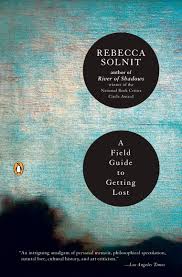
Rebecca Solnit, whose mind and writings are among the most consistently enchanting of our time, explores this tender tango with the unknown in her altogether sublime collection of essays in A Field Guide to Getting Lost 

I thoroughly enjoy her writings, having indulged in a few of her books and essays. And Getting Lost is one of the more personally transformative collection of essays I have had the pleasure of reading. Solnit, explores themes and issues of uncertainty, trust, loss, memory, desire, and our place on this planet.

Solnit writes in the opening essay:

Leave the door open for the unknown, the door into the dark. That’s where the most important things come from, where you yourself came from, and where you will go. The things we want are transformative, and we don’t know or only think we know what is on the other side of that transformation. Love, wisdom, grace, inspiration — how do you go about finding these things that are in some ways about extending the boundaries of the self into unknown territory, about becoming someone else?

Henry Miller wrote: “On how one orients himself to the moment, depends the failure or fruitfulness of it.” we are all apart of this transitional process called – Life.

“There is an illusion of ‘end,’ a stasis seemingly like death. But it is only an illusion. Everything, at this crucial point, lies in the attitude which we assume towards the moment.”

Henry Miller

T.S. Eliot’s poem Four Quarters –  expounds on the journey of life and its self discovery, and ultimately learning to know ourselves. we are on a never-ending lifelong journey of exploration – of our self, environment, the world in which we live.Life is a destination, but prehaps we never really travel further than we really are at this present moment, all that changes is our understanding of the now …

“We shall not cease from exploration
And the end of all our exploring
Will be to arrive where we started
And know the place for the first time.”
T. S. Eliot, Four Quartets

The things we want are transformative, and we don’t know or only think we know what is on the other side of that transformation. Sometimes we have to lose ourselves to find ourselves. Never to get lost is not to live.

index

Wise words from Bob Dylan

It’s not to anybody’s best interest to think about how they will be perceived tomorrow. It hurts you in the long run.

Still in Turmoil… but getting settled

Well I am back and settling down to my new routine and getting my new studio/office up and running. Have been spending time developing one of the 3 projects I am working on (it has been tricky, being creative when one is moving, travelling, unpacking).

Have spent this time fleshing out a detailed introduction and end chapter, and am now adding weight to the main body of the novel and doing the necessary research to add more substance to the plot. Miss the large whiteboards that I would need to mind map my project better and also my sketch table…as I find that I do doodling and sketching of certain sections/concepts of the novel, it helps me with my ideas and to map out what goes on in my mind (scary thought!). Anybody else use sketching/doodling to help with the creative flow??

I have also found that by selecting music that I feel best suits the project, has been very useful in adding more creative input in my writing process. I have made a playlist for this project and have found this to be very useful, for added inspiration and additional ideas for the novel.

That’s it for now, hope to be posting more as I move forward.